What is Agonal Breathing? (Definition)
Agonal breathing is one of the most critical signs of a life-threatening emergency, yet many people do not recognize it when it occurs. This unusual breathing pattern often appears during cardiac arrest, giving bystanders the false impression that a person is still breathing adequately. Understanding agonal respirations and knowing how to respond can dramatically increase survival rates. Because emergencies happen without warning, recognizing this pattern and acting quickly can save a life.
What Does Agonal Breathing Look Like and Feel Like?
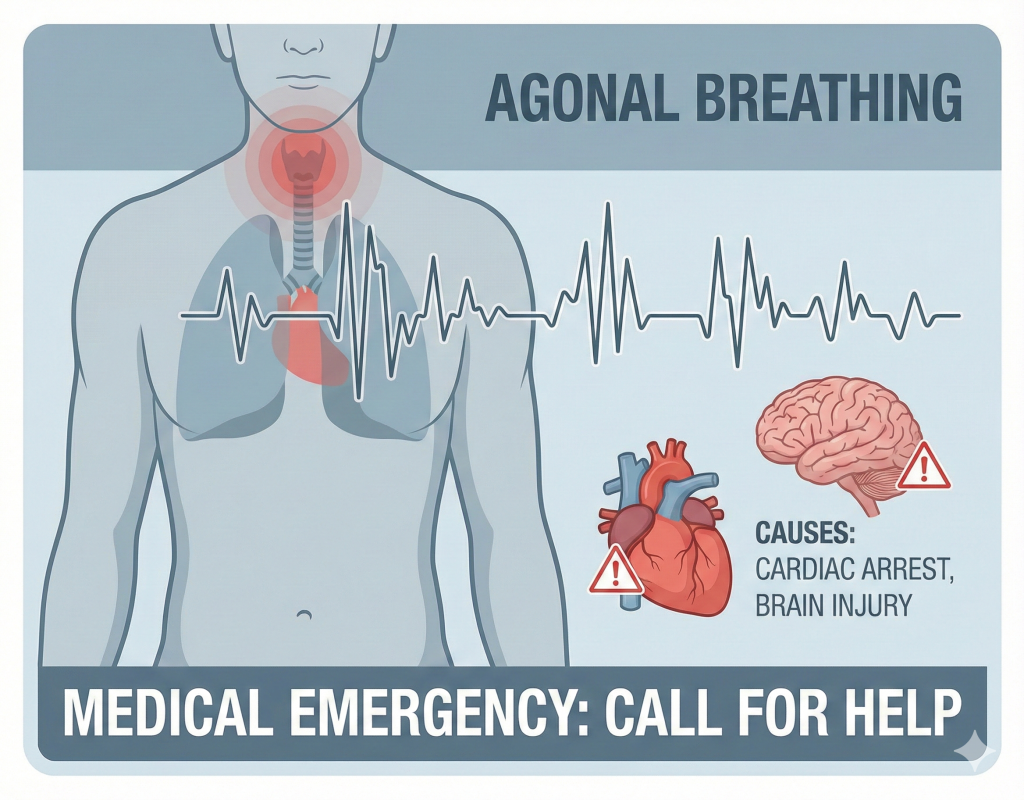
Agonal breathing is defined as irregular, gasping respirations that occur when the brain is no longer receiving enough oxygen. Unlike normal breathing, which is steady and purposeful, agonal respirations are uncoordinated and ineffective. They may happen only a few times per minute and lack the strength needed to supply the body with oxygen. The term agonal refers to the body’s final attempts at life during the dying process. These gasps should always be treated as a red flag indicating severe distress, most commonly cardiac arrest. People who witness such breathing often think the person is still alive and stable, but agonal respirations signal the exact opposite: the body is failing and needs immediate intervention.
Visual Signs
Visually, agonal breathing is unmistakable once you know what to look for. It often resembles a fish-out-of-water motion, with the jaw opening and closing as the person struggles for air. Although some chest movement may be visible, it is usually shallow and ineffective. Sometimes muscle twitching or seizure-like jerks accompany the gasps, adding confusion for bystanders.
What the Person May Experience
In most cases, the person experiencing agonal breathing is unconscious. They cannot speak, respond, or move meaningfully. Because they are unconscious, they are not aware of what is happening and are not experiencing pain or discomfort. The key point is that although the body appears to be trying to breathe, this effort is not enough to sustain life.
Common Misconceptions
Misunderstanding agonal breathing is common. Many well-meaning bystanders assume that any visible breathing means a person does not need CPR. This misconception can be fatal. Agonal respirations are not a sign of recovery and are not an indication that the heart is functioning. Instead, they are the brain’s last reflexive attempt to breathe despite the absence of adequate circulation. Waiting for agonal breathing to normalize wastes precious time. CPR should begin immediately when this breathing pattern is observed.
What Causes Agonal Breathing?
Primary Medical Emergencies
Several medical emergencies can lead to agonal breathing. Cardiac arrest is by far the most common cause, occurring when the heart abruptly stops pumping blood. Severe strokes, traumatic brain injuries, and certain drug overdoses can also trigger this breathing pattern.
Call Us Now
Get the Best CPR Class in Indianapolis Today!
From a physiological standpoint, agonal breathing happens because the brain stem continues making a final attempt to initiate breathing even after normal control centers fail. Without oxygen, the brain quickly loses function, and the body begins shutting down.
This breathing pattern appears within minutes of cardiac arrest and may last only a short period before respirations stop altogether. Because it signals imminent death without intervention, recognizing and responding to agonal breathing is essential.
What Should I Do If Someone Is Experiencing Agonal Breathing?
If you encounter someone with agonal breathing, treat it as a cardiac arrest emergency. Do not wait to see if their breathing improves—take action immediately:
Step 1: Call 911 – Alert emergency services right away or have someone else call while you prepare to help.
Step 2: Check for Responsiveness – Tap the person’s shoulder and shout to see if they respond. If there’s no response and they’re exhibiting agonal breathing, assume cardiac arrest.
Step 3: Begin CPR – Start chest compressions immediately. Push hard and fast in the center of the chest at a rate of 100-120 compressions per minute. If you’re trained in CPR, provide rescue breaths as well (30 compressions to 2 breaths).
Step 4: Use an AED – If an automated external defibrillator is available, use it as soon as possible. Follow the device’s voice prompts.
Don’t let agonal breathing fool you into thinking the person doesn’t need help. Studies show that bystanders often fail to recognize cardiac arrest when agonal breathing is present, leading to delayed CPR. Your quick action can save a life.
Why Does Agonal Breathing Happen During Cardiac Arrest?
Agonal breathing occurs as a primitive brainstem reflex when the brain is severely deprived of oxygen. When the heart stops pumping blood effectively, oxygen delivery to the brain drops dramatically. The brainstem—the most basic part of the brain responsible for automatic functions—attempts to stimulate breathing as a last-ditch effort to restore oxygen.
However, these reflexive gasps are ineffective because:
- The heart isn’t pumping blood to carry oxygen throughout the body
- The breathing pattern is too irregular to maintain adequate gas exchange
- There’s insufficient muscle coordination for effective respiration
Agonal breathing is actually a positive sign in one important way: it indicates that cardiac arrest has occurred very recently, meaning CPR and defibrillation have a better chance of success. The presence of agonal breathing typically means the person has been in cardiac arrest for less than a few minutes, and prompt intervention can potentially restore normal heart rhythm.
This is why proper training is so important. Healthcare providers and even laypersons with CPR certification learn to recognize agonal breathing as a call to action rather than a sign that the person is breathing adequately.
Conclusion
Recognizing agonal breathing is a critical skill that can help you save someone’s life during a cardiac arrest emergency. These irregular, gasping breaths are not effective respirations but rather a sign that immediate CPR is needed. By understanding the characteristics of agonal breathing and knowing how to respond, you become empowered to act confidently in an emergency.
The knowledge of when and how to perform CPR shouldn’t be limited to healthcare professionals. Every second counts during cardiac arrest, and bystander CPR dramatically increases survival rates. Don’t let uncertainty or misidentification of agonal breathing prevent you from taking life-saving action.
Call to Action
Are you prepared to recognize agonal breathing and respond effectively in an emergency? CPR Indianapolis offers comprehensive, hands-on training that prepares you for real-world situations. As an American Heart Association training site, we provide stress-free instruction in BLS for Healthcare Providers, ACLS, PALS, and CPR and First Aid courses.
Whether you need CPR certification in Indianapolis for your profession or want to be prepared to help in any emergency, our BLS classes in Indianapolis give you the confidence and skills to save lives. Our expert instructors focus on practical, hands-on training so you’ll know exactly what to do when it matters most.
Don’t wait until an emergency happens. Contact CPR Indianapolis today to schedule your certification or renewal class. Be the difference between life and death—get trained, stay current, and be ready to act.


